

Quick answer: Floodwater is always treated as Category 3, the most contaminated class, because rain that crosses streets, lawns, and storm drains picks up bacteria, chemicals, and sewage. Standard homeowners policies exclude flooding, so Kansas City homeowners need separate flood coverage, and sewer or sump pump backup is a different endorsement. Cleanup should start within hours, using antimicrobial treatment rather than household cleaners.
If you've lived in the Kansas City metro through more than one storm season, you already know something people who move here from flatter, drier places don't: our floods don't creep in slowly. They show up fast, they show up hard, and they're usually gone within a few hours - leaving behind a mess that takes weeks to fully understand.
This isn't a guide about what water damage is or how extraction equipment works. You've probably read that version already. This is a guide about Kansas City specifically: why our neighborhoods flood the way they do, what to actually do before the next storm rolls through, and where homeowners in this region keep making the same costly mistakes with insurance and cleanup.
Storm Season in Kansas City: When Flash Flood Risk Is Highest
Before getting into what makes local flooding unique, it helps to know when to actually be paying attention. In the Kansas City metro, flash flood risk isn't spread evenly across the year; it's concentrated in a fairly predictable window.
Late spring and early summer are, by far, the highest-risk months for flash flooding in this region. This is when warm, moisture-heavy air collides with cooler fronts moving through the Plains, producing the kind of fast-building thunderstorms that can drop several inches of rain in under an hour. Unlike a steady, all-day rain event, this sudden heavy rainfall doesn't give the ground or the storm drains any time to keep up.
A few things to keep in mind as storm season approaches:
- Flash Flood Warnings issued by the National Weather Service for this area are typically short-fuse alerts, often giving only 30 to 60 minutes of notice before water rises significantly. This is very different from a river flood warning, which can be issued days in advance.
- Storm activity tends to peak in the late afternoon and evening hours during late spring and early summer, when daytime heating adds extra energy to developing storm systems.
- A quiet morning doesn't mean a quiet evening - some of the worst flash flood events in this region have developed within a few hours, with little warning earlier in the day.
- Homeowners who've flooded before are far more likely to flood again during this same window each year, which is exactly why preparation should happen before storm season starts, not once the first warning is issued.
Knowing this pattern doesn't prevent flooding, but it does change how homeowners prepare. Checking sump pumps, clearing window wells, and reviewing insurance coverage in early spring before the first serious thunderstorm rolls through puts you in a very different position than scrambling once a Flash Flood Warning is already active.
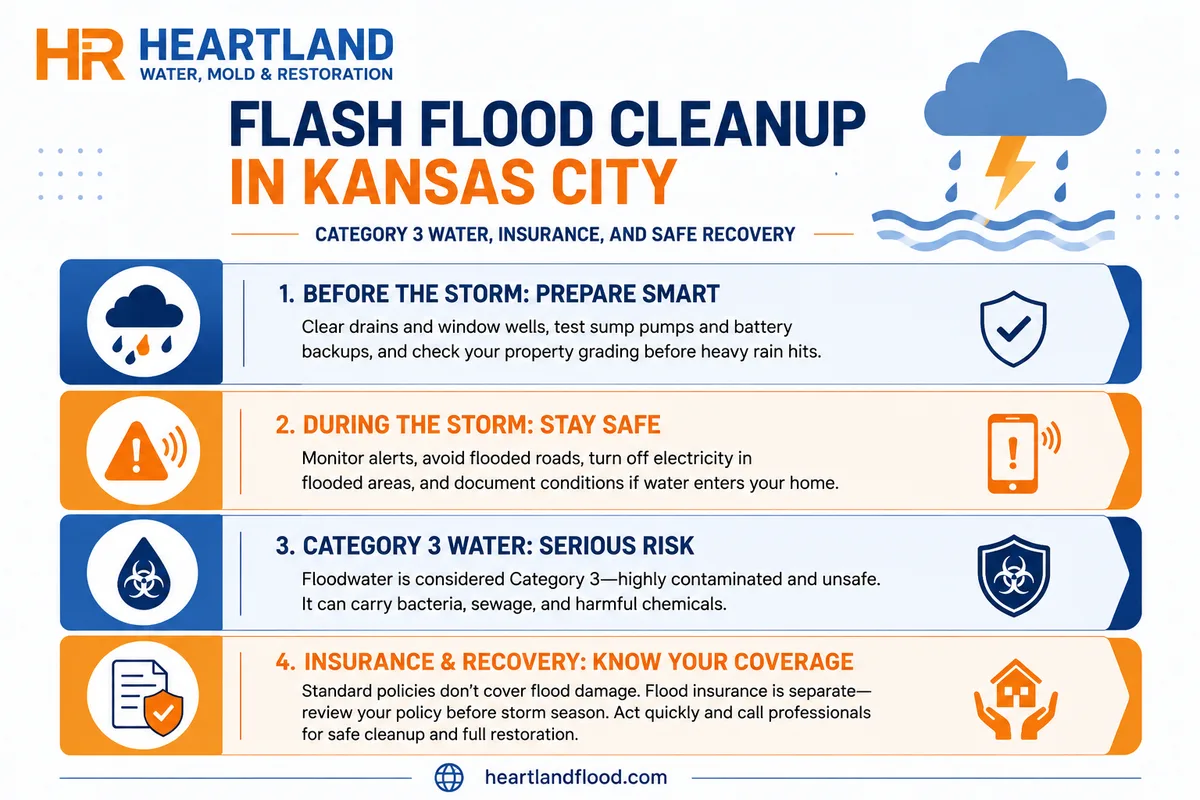
Why Kansas City's Landscape Turns Rain Into a Flash Flood Problem
Kansas City sits at the confluence of two major rivers, but the bigger issue for most homeowners isn't the Missouri or the Kansas River itself - it's the dense network of smaller creeks, drainage channels, and clay-heavy soil that make up the region's terrain.
A few things work against us here:
- Clay soil doesn't absorb water quickly: When three inches of rain fall in an hour, the ground simply can't keep up, and that water has nowhere to go but downhill - often straight toward the nearest basement.
- Rolling terrain concentrates runoff: Neighborhoods built into hillsides or near creek beds act like funnels during heavy storms.
- Older infrastructure in parts of the urban core: It wasn't designed for the rainfall intensity we now see regularly, so storm drains back up faster than they did decades ago.
This combination is exactly why a house in Kansas City can flood in under 90 minutes while a similar home in a flatter region might never see standing water at all.
Why Certain Neighborhoods Flood Over and Over
If your street floods every time there's a heavy storm, it's not bad luck - it's topography and drainage history repeating itself.
Homeowners near Brush Creek, Indian Creek, and the Blue River corridor tend to see repeat flooding because these waterways were never meant to handle the volume of runoff coming from decades of new development upstream. That pattern shows up in older, established neighborhoods across the metro, but it's not limited to them - even newer subdivisions in Kansas suburbs can experience flash flooding when drainage easements weren't graded correctly during construction, something a lot of homeowners don't discover until the first major storm hits.
If you've flooded more than once, it's worth having someone look at your property's grading and drainage path specifically, rather than assuming it's simply "bad weather."
Before the Storm: What Actually Helps
Most flood preparedness advice online is generic. Here's what actually matters for homes in this region:
- Clear window wells covered: Before storm season - clogged wells are one of the most common entry points for basement flooding in older KC homes.
- Check your sump pump's battery backup: Not just the pump itself. Kansas City storms frequently knock out power at the exact moment the sump pump is needed most.
- Walk your property's grading: After any landscaping work. A single low spot near the foundation can redirect an entire storm's runoff toward your house.
- Know your flood zone status: But don't rely on it exclusively. A large share of flash flood claims in this metro come from homes outside official FEMA flood zones.
During the Storm: Decisions That Actually Matter
When a flash flood warning hits for the Kansas City metro, the decisions that matter most happen in the first 30 minutes.
- Move anything irreplaceable off the basement floor immediately - photos, documents, electronics, rather than waiting to see how bad it gets.
- Avoid driving through flooded streets, even ones you know well. Water depth is deceptive at night and during heavy rain, and it's one of the leading causes of storm-related injury in this region every year.
- If water is entering through a window well or door, don't try to block it with towels alone - prioritize protecting electrical panels and outlets first.
- Once water is inside, your priority shifts from prevention to documentation, which matters more than most people realize once insurance gets involved.
Why Floodwater Is Always Treated as Category 3 - No Exceptions
There's a common assumption that if the water "just looks like rain," it's probably clean. It isn't, and this matters more than most homeowners realize.
Once rainwater travels across a street, a parking lot, a lawn treated with fertilizer, or through a storm drain, it's picked up bacteria, chemical residue, and often sewage from overwhelmed municipal systems. That's why every flash flood event, regardless of how the water entered your home, gets treated as Category 3 contamination. This isn't overcaution - it's the standard because the alternative is guessing wrong about what's actually in your basement, and that guess can affect your family's health.
Hidden Dangers People Don't Think About After the Water's Gone
The visible damage is rarely the whole story. Some of the most serious issues show up after everything looks dry.
- Odor without visible water: Often means moisture is trapped inside a wall cavity or under flooring, not that the damage has resolved.
- Musty basements weeks later: It's usually a sign of mold growing in a spot that wasn't fully dried - insulation and drywall behind baseboards are common culprits.
- Warped or "bouncy" flooring: It can indicate subfloor damage that wasn't visible during the initial cleanup.
- Electrical issues appearing days later: Flickering lights, tripped breakers - can be a delayed sign of moisture that reached wiring or outlets during the flood.
- A recurring "wet basement smell" every time it rains: Usually means the original flooding created a pathway that's still letting moisture in.
If any of these show up in your home, it's worth having it looked at rather than assuming the worst is behind you.
Flood Insurance vs. Water Backup Coverage: Where Kansas City Homeowners Get It Wrong
This is, without question, the area where local homeowners lose the most money after a storm - not because the damage was uninsurable, but because they had the wrong type of coverage, or assumed coverage they didn't actually have.
Standard homeowners insurance does not cover flooding. This catches people off guard every single storm season, because the same policy usually does cover a burst pipe or an appliance failure. Flooding meaning rising water from outside the home, whether from a creek, storm runoff, or heavy rain pooling against the foundation is excluded from nearly every standard homeowners policy in the country, and Kansas City is no exception.
Flood insurance is a separate policy, typically through the National Flood Insurance Program or a private flood carrier. A few things trip up homeowners here:
- There's usually a waiting period of 30 days before a new flood policy takes effect, meaning you can't buy it once a storm is already forecasted.
- Being outside a designated flood zone does not mean you're safe from flash flooding, and lenders often don't require this coverage outside those zones, so many homeowners simply don't have it.
- Flood policies generally need to be purchased well before storm season, not reactively after the first bad forecast.
Water backup coverage is a different endorsement entirely, and this is where a lot of confusion happens. This coverage responds when water backs up through a sewer line, drain, or sump pump failure - not when floodwater rises from outside and enters the home. A homeowner in Lee's Summit whose basement flooded because a nearby creek overflowed needs flood insurance for that claim. A homeowner in Shawnee whose basement flooded because the municipal sewer backed up under storm pressure may find that a water backup endorsement is what actually applies - and it's common for people to have one of these coverages and assume it covers both situations.
Common Insurance Mistakes We See After Every Storm Season
- Assuming a standard homeowners policy will cover flash flood damage
- Not realizing there's a waiting period before new flood coverage becomes active
- Filing under the wrong coverage type and having the claim denied, then not realizing they can appeal or clarify the cause of loss
- Throwing away damaged items before documenting them, which weakens the claim significantly
- Not knowing the difference between "flood" and "backup" causes of loss when speaking to an adjuster
If you're unsure which coverage applies to your situation, it's worth calling your agent before storm season - not after the water's already in your basement.
Mistakes Homeowners Make During Flash Flood Cleanup
Beyond insurance, there are a few cleanup mistakes that are specific to how fast Kansas City storms move:
- Waiting to see if it "dries out on its own": With Category 3 water, delay is the single biggest factor in whether damage stays contained or spreads.
- Running a household dehumidifier and assuming it's enough: Consumer units aren't built for the volume of moisture a flash flood leaves behind in framing and subflooring.
- Cleaning contaminated water with regular household cleaners: Floodwater contamination needs specific antimicrobial treatment, not general-purpose disinfectant.
- Not checking crawl spaces or under-basement-stair storage: These areas are easy to overlook and are exactly where hidden mold problems start.
Preparing Your Property Before Next Storm Season
Kansas City's storm pattern means it's never really a matter of "if" for homes in flood-prone areas - it's "when." A few practical steps make the biggest difference:
- Reassess your grading and drainage every couple of years, especially after any landscaping or construction nearby
- Keep a simple inventory (photos are enough) of your basement's contents, updated seasonally
- Confirm your flood insurance policy is active well before storm season starts, not during it
- Know which coverage flood or backup applies to your specific risk, and carry both if your property has a history of either
When You Need Help Fast
Storm weeks in Kansas City don't leave much room for research. If your basement has flooded, or a storm is bearing down and you want a plan in place, Heartland Restoration works throughout the metro on both the Kansas and Missouri sides, and understands the drainage patterns and flood history behind most calls we get.
Whether you're dealing with active basement flooding right now or just want a second opinion on damage that's been sitting since the last storm, having someone local who's seen the same creek overflow the same way before makes the process faster and less confusing. Heartland Restoration has built its approach around exactly that kind of regional familiarity, because a flood near a creek corridor doesn't behave the same way as one in a newer suburban subdivision and the response shouldn't either.
If you're searching for help during an active storm event, visit heartlandflood.com - the sooner floodwater is addressed, the fewer hidden problems you'll be dealing with weeks from now.
Related Reading
Last updated August 14, 2026
Frequently Asked Questions About Flash Flood Cleanup in Kansas City
Why is floodwater treated as Category 3 water?
Floodwater crosses streets, parking lots, treated lawns, and storm drains before it reaches a home, picking up bacteria, chemicals, and often sewage from overwhelmed systems. Because the contents cannot be known, every flash flood is classed as Category 3, which requires protective equipment, removal of porous materials, and antimicrobial treatment rather than ordinary cleaning.
Does homeowners insurance cover flash flood damage in Kansas City?
Usually not. Standard homeowners policies exclude flooding, meaning rising water from creeks, runoff, or rain pooling against the foundation. Flood coverage is a separate policy through the National Flood Insurance Program or a private carrier. Check with your agent before storm season about both flood and water backup coverage.
What is the difference between flood insurance and water backup coverage?
Flood insurance responds to water that rises from outside and enters the home. Water backup coverage is an endorsement that responds when water backs up through a sewer line, drain, or failed sump pump. A basement flooded by an overflowing creek and one flooded by a backed-up municipal sewer can involve different coverage.
How long does a new flood insurance policy take to start?
A new National Flood Insurance Program policy typically has a 30 day waiting period before coverage begins. That means flood coverage generally cannot be bought once a storm is already forecast. Confirm the waiting period and effective date with your agent well before late spring, when Kansas City flash flood risk is highest.
Can I clean up floodwater myself?
Small cleanups are risky because floodwater is Category 3. Household cleaners do not treat floodwater contamination, consumer dehumidifiers cannot dry framing and subfloors, and waiting to see if it dries on its own lets moisture spread. Contaminated flooding calls for professional extraction, antimicrobial treatment, and structural drying with documented moisture readings.
What are signs of hidden damage after a flood?
Warning signs include odor with no visible water, a musty basement weeks later, warped or bouncy flooring, flickering lights or tripped breakers days afterward, and a wet basement smell whenever it rains. Each can mean moisture is still trapped in a wall cavity, subfloor, or insulation and should be inspected.
Sources & References
- National Flood Insurance Program - Flood Insurance & Recovery Guidance - FEMA (Federal Emergency Management Agency)
- National Weather Service Flood Safety - NOAA National Weather Service
- ANSI/IICRC S500 Standard for Professional Water Damage Restoration - IICRC (Institute of Inspection, Cleaning and Restoration Certification)
Comments
No comments yet.