
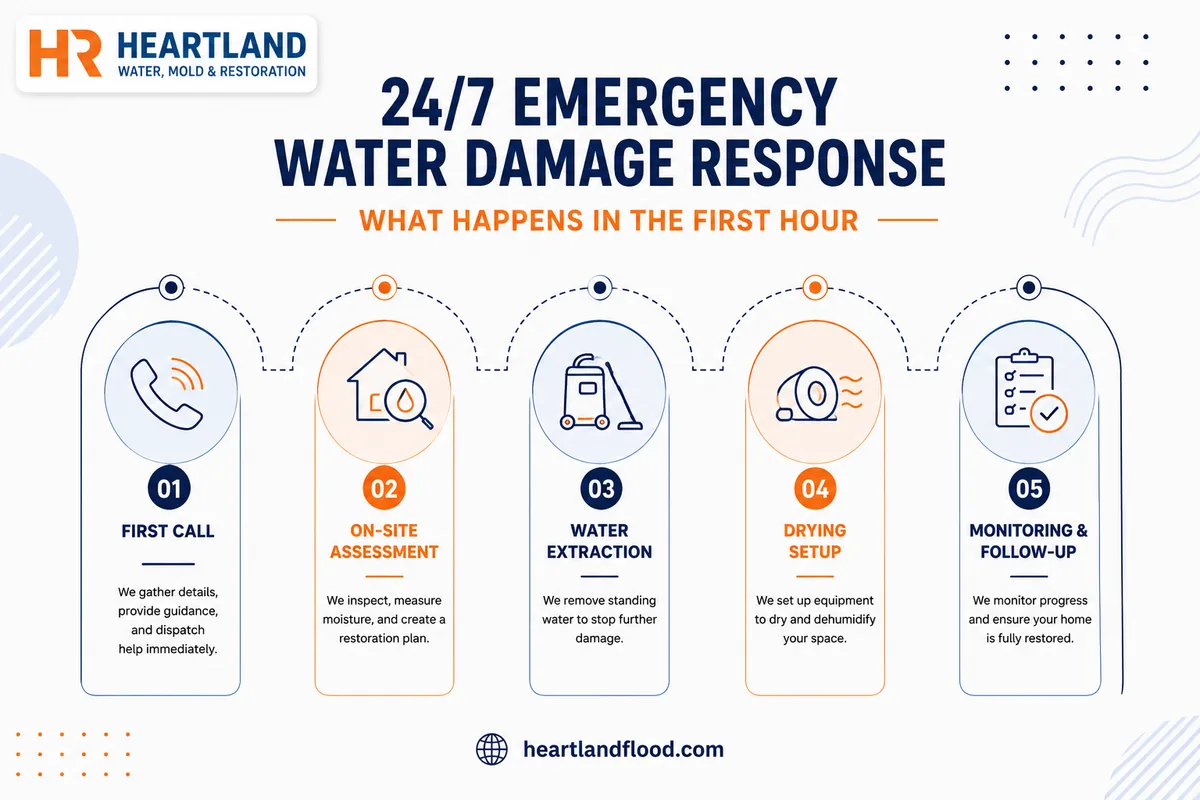
Quick answer: A professional 24/7 emergency water damage response runs in five phases: an intake call that dispatches the right crew and equipment, an on-site moisture assessment, water extraction, structural drying with air movers and dehumidifiers, and monitoring visits every day or two. Typical Kansas City mitigation costs range from about $1,800 for a small appliance loss to $14,000 for a finished basement with drywall removal.
Water damage is one of those home emergencies that punishes hesitation. Whether it is a burst pipe in the middle of the night or a sump pump failure during a Kansas City spring storm, the first hour of response determines how far the damage spreads, how long the drying phase runs, and ultimately how large your restoration bill becomes.
This guide walks through the exact process a professional 24/7 emergency water damage team follows phase by phase and pairs it with honest, transparent pricing so homeowners know what to expect before they ever pick up the phone.
The First Call: What Happens When You Dial for Emergency Water Damage Help
The intake call is more structured than most people expect. A trained dispatcher is not just collecting your address, they are gathering information that determines which crew responds, how much equipment gets loaded, and how quickly the team can move once on-site.
You will be asked about the water source (burst pipe, appliance overflow, roof intrusion, sump pump failure), whether the source has been shut off, the approximate size of the affected area, and whether there are any immediate safety concerns such as electrical panels or gas lines near the water.
If you have not shut off the water yet, a professional dispatcher will walk you through locating your main shutoff while the crew is already in transit. That two-minute conversation can prevent hundreds of additional gallons from entering the structure.
Response time matters here: Heartland Restoration holds a written 60-90 minute response commitment across the Kansas City metro, covering Overland Park, Lenexa, Lee's Summit, Independence, Shawnee, and Parkville, because the team understands that every additional minute of contact time between water and building materials increases the scope of what follows.
On-Site Arrival: Assessment Before Any Work Begins
The first thing a professional crew does upon arrival is not grab extraction equipment. It is assessed. This is the step that separates restoration work from reactive cleanup and it is where the quality of the entire job gets determined.
Technicians conduct a full moisture assessment of the affected area using moisture meters and thermal imaging. Moisture meters measure actual water content inside walls, flooring, and framing, not just surface wetness. Thermal imaging identifies cold spots caused by hidden moisture inside wall cavities, under floors, and above ceilings that have no visible sign of water on the surface.
A kitchen supply line failure, for example, may show a visible 4-foot radius of wet flooring. Thermal imaging routinely reveals that water has migrated 8 to 10 feet further inside the wall assembly, an area that would go completely untreated without instrument-based assessment, and that would develop mold behind drywall within three to four weeks.
The assessment produces a moisture map of the structure. Every test point is recorded with a reading before work begins. That documentation serves two purposes: it drives all equipment decisions, and it becomes the baseline for your insurance claim.
Why this step protects your wallet: Crews that skip assessment and go straight to demolition may remove materials that could have been saved with proper drying and insurers reviewing documentation may dispute demolition that was not supported by moisture readings.
Water Extraction: The Phase With the Biggest Impact on Your Final Cost
Once the moisture map is complete, extraction begins. This is the most time-sensitive phase of the entire response. The volume of water removed in extraction directly determines the length of the drying phase, and drying duration is one of the largest cost variables in any water damage job.
Professional extraction equipment operates at a fundamentally different level than consumer wet/dry vacuums. Commercial units pull water from carpet backing, subfloor surfaces, and even the top layer of hardwood flooring using high-capacity extraction at rates that consumer equipment cannot approach.
- Carpet pad: Once fully saturated, carpet pad retains moisture in its core even after surface readings normalize. Standard industry practice is to remove and dispose of saturated pad while drying and retaining the carpet itself where the carpet is in good condition and is not contaminated.
- Drywall decisions: Drywall that has absorbed water past a certain threshold needs to be removed rather than dried in place the paper facing deteriorates, and hidden moisture becomes a mold source weeks later. A controlled "flood cut" removes only the affected section, preserving as much of the structure as possible while ensuring the wall cavity can dry completely. This decision is made based on moisture readings, not on appearance alone.
For a typical flooded main floor in Kansas City two rooms affected by a burst pipe with no ceiling involvement extraction runs approximately 30 to 45 minutes of active work.
Structural Drying Setup: The Equipment That Stays With Your Home
After extraction, the crew sets up commercial drying equipment that remains in your home for the duration of the drying phase, typically three to five days for a moderate water event, longer for heavily saturated structures or finished basements.
- Industrial air movers: Direct high-velocity airflow across wet surfaces and along floor-wall junctions, accelerating evaporation out of flooring, baseboards, and wall assemblies. Their placement follows the moisture map directly; each unit is positioned to address specific wet zones, not simply distributed around the room.
- Commercial dehumidifiers: Remove the evaporated moisture from the air before it can settle into unaffected materials nearby. Without dehumidification running alongside air movers, the drying process simply redistributes moisture through the air rather than removing it from the structure.
- The number of units placed is calculated based on the affected square footage, ceiling height, and material types not estimated casually. A finished basement flood in Kansas City typically requires six to ten air movers and two to three dehumidifiers running continuously.
- Monitoring visit: A required part of professional drying not optional check-ins. Technicians return every 24 to 48 hours, take new moisture readings at every documented test point, adjust equipment positioning as materials dry, and update the drying log. Drying is declared complete only when all readings return to dry standard. "Looks dry" is not a standard. Documented moisture readings are.
Emergency Water Damage Cost: What to Expect
The restoration industry has a reputation for vague estimates and surprise invoices. Below is a straightforward breakdown of typical Kansas City cost ranges for emergency water damage mitigation in 2026. Final pricing depends on the water category, the materials involved, and how long the water has sat, so treat these as planning ranges and ask for a written scope.
Water Extraction
Extraction is priced per affected square foot and varies by material type.
| Material | Cost per Square Foot |
|---|---|
| Carpet (including pad removal) | $3.50 - $5.50 |
| Hardwood / engineered wood | $5.00 - $8.00 |
| Vinyl, tile, or concrete | $2.50 - $4.50 |
Structural Drying Equipment
Equipment is billed per unit per day. Most residential drying phases run 3 to 5 days.
| Equipment | Daily Rate |
|---|---|
| Commercial air mover | $25 - $45 per unit |
| Commercial dehumidifier | $75 - $130 per unit |
Controlled Demolition (When Required)
When drywall or insulation must be removed to allow proper drying:
| Scope | Cost |
|---|---|
| Flood cut drywall removal | $1.50 - $3.50 per square foot |
| Baseboard removal and disposal | $1.50 - $2.50 per linear foot |
Total Mitigation Cost by Job Type
| Common Kansas City Loss Scenario | Estimated Mitigation Cost |
|---|---|
| Burst pipe: 2 rooms, main floor, no demo | $2,200 - $4,500 |
| Appliance failure: kitchen and adjacent area | $1,800 - $3,500 |
| Finished basement flood (sump pump failure): 600-1,000 sq ft | $4,500 - $9,000 |
| Finished basement flood with drywall removal: 800-1,200 sq ft | $7,000 - $14,000 |
These figures cover the mitigation phase: extraction, drying, and demolition where needed. Reconstruction (drywall replacement, flooring installation, painting) is a separate scope that follows once the structure reaches dry standard.
Insurance: What Typically Applies
Standard homeowners policies in Kansas and Missouri generally cover sudden and accidental internal water damage, burst pipes, supply line failures, and appliance overflows. Flooding from external stormwater or groundwater typically requires a separate flood policy.
Heartland Restoration provides direct insurance billing and complete documentation packages moisture maps, equipment logs, timestamped photos, and written scope to all major carriers serving the Kansas City area. Homeowners never have to chase their own paperwork.
What to Look for in a 24/7 Emergency Water Damage Company in Kansas City
Not every company that answers the phone at 2 a.m, operates to the same standard. Here is what distinguishes a professional response from one that creates problems down the road.
Signs of a professional operation
- Moisture readings documented before extraction begins
- Written scope of work provided before demolition
- IICRC-certified technicians on every job
- Return monitoring visits on a 24 to 48-hour schedule
- Drying completion confirmed by instrument readings, not visual assessment
- Full documentation package provided for insurance
Warning Signs That Should Raise Concerns
- Demolition begins without moisture testing
- Verbal-only estimates with no written scope
- Equipment dropped off with no follow-up monitoring
- Pressure to sign over insurance benefits before your claim is reviewed
IICRC certification, specifically the Water Damage Restoration Technician credential, means a technician has been formally trained in moisture science, drying protocols, and documentation standards. It is the baseline qualification, not a premium differentiator, and you should ask for it before work begins.
Choosing the Right Emergency Water Damage Restoration Company
Heartland Restoration is a family-owned, IICRC-certified company serving the Kansas City metro. The team responds to water damage emergencies across Kansas City including Overland Park, Lee's Summit, Shawnee, Independence, Lenexa, and Parkville with a written 60-90 minute response commitment and direct insurance billing on every job.
Every moisture reading is documented from the first minutes on-site. Every equipment decision is driven by that documentation. And every homeowner gets a clear explanation of the scope, the timeline, and the cost before major work begins.
For 24/7 emergency water damage response across the Kansas City metro, call Heartland Restoration at (913) 213-3686.
Related Reading
Last updated September 23, 2026
Frequently Asked Questions About Emergency Water Damage Response
What happens in the first hour of an emergency water damage response?
A dispatcher takes the intake call, asks about the water source, shutoff, affected area, and safety concerns, and sends the right crew and equipment. On arrival the technicians take moisture readings with meters and thermal imaging, build a moisture map, then begin extraction. Heartland commits to a written 60-90 minute response across the Kansas City metro.
How long does structural drying take after water extraction?
A moderate residential water event typically needs three to five days of drying with industrial air movers and commercial dehumidifiers, longer for heavily saturated structures or finished basements. Technicians return every day or two to take new moisture readings and adjust equipment until every documented test point reaches the dry standard.
How much does emergency water damage mitigation cost in Kansas City?
Planning ranges for 2026 run from roughly $1,800 to $3,500 for an appliance failure and $2,200 to $4,500 for a two-room burst pipe, up to $4,500 to $9,000 for a finished basement flood and $7,000 to $14,000 when drywall removal is needed. Reconstruction is a separate scope that follows once the structure is dry.
Does homeowners insurance cover emergency water damage?
Standard Kansas and Missouri policies generally cover sudden and accidental internal water damage such as burst pipes, supply line failures, and appliance overflows. Flooding from external stormwater or groundwater usually requires a separate flood policy. Moisture maps, equipment logs, timestamped photos, and a written scope help support the claim.
What should I look for in a 24/7 water damage company?
Look for moisture readings documented before extraction, a written scope before demolition, IICRC-certified technicians, monitoring visits every 24 to 48 hours, drying confirmed by instrument readings, and a full insurance documentation package. Warning signs include demolition without moisture testing, verbal-only estimates, and pressure to sign over insurance benefits.
Why is water extraction so important to the final cost?
The more water removed during extraction, the less moisture the drying phase has to evaporate, and drying duration is one of the largest cost drivers in any water damage job. Commercial extraction pulls water from carpet backing, subfloor surfaces, and even hardwood at rates household wet vacuums cannot match.
Sources & References
- ANSI/IICRC S500 Standard for Professional Water Damage Restoration - IICRC (Institute of Inspection, Cleaning and Restoration Certification)
- National Flood Insurance Program - Flood Insurance & Recovery Guidance - FEMA (Federal Emergency Management Agency)
Comments
No comments yet.