
Quick answer: DIY water damage cleanup is reasonable only when the volume is small, the water has sat for hours rather than days, the surface is non-porous, and the source is clean. If water has reached drywall, insulation, or subfloor, has stood more than a day, or came from a sewage backup or exterior flooding, you need professional drying with moisture meters to confirm the structure is truly dry.
Water damage is one of the more deceptive problems a homeowner can encounter. The visible signs - a wet patch on the ceiling, a damp baseboard, water pooling near an appliance - rarely reflect the full scope of what is happening underneath. By the time damage becomes obvious in Kansas City homes, moisture has often already worked its way into subflooring, wall cavities, or insulation: areas no amount of surface cleanup can reach.
Deciding whether to manage that cleanup independently or bring in a professional restoration team is rarely as straightforward as it looks at the moment. This guide focuses on that single decision: when DIY water damage cleanup is genuinely appropriate, and when it isn't.
What Counts as Water Damage, and Why the Source Matters
Restoration professionals classify water intrusions into three categories, and the category determines almost everything about how a situation should be handled.
- Category 1 - clean water: supply lines, appliances, rainfall. Generally the safest starting point for DIY.
- Category 2 - gray water: contains contaminants. Washing machines, dishwashers, aquariums. Requires more caution than most homeowners apply.
- Category 3 - black water: sewage backups, exterior flooding. Poses genuine health risks and should not be handled without protective equipment and professional protocols.
The distinction matters more than most people realize at the time. A supply line failure and a sewage backup may both leave standing water in a basement, but they are entirely different problems. It is also worth noting that clean water does not stay clean. Left untreated for more than 48 hours, it begins supporting bacterial growth and is effectively reclassified as gray water which changes the cleanup standard entirely.
Why the First Few Hours After Water Damage Define the Outcome
Most homeowners underestimate how quickly building materials absorb and hold moisture. Drywall that stays wet for more than a day or two becomes a viable environment for mold spores already present in normal indoor air. Hardwood flooring exposed to standing moisture over a weekend can cup, warp, or delaminate in ways refinishing cannot fix. Insulation saturates quickly and almost never dries on its own even when surrounding surfaces feel dry to the touch.
The practical implication is straightforward: a leak caught and addressed the same day is a very different problem than one left to sit while waiting for a convenient time to deal with it. The first scenario typically involves a modest mitigation bill. The second can escalate into drywall replacement, flooring repair, and mold remediation three separate scopes of work instead of one.
When DIY Water Damage Cleanup Is a Reasonable Option
A meaningful share of water events are genuinely manageable without professional help. A toilet overflow caught immediately, a small appliance leak with no standing water, or surface moisture on tile or sealed concrete addressed within the first couple of hours - these fall well within what a wet/dry vacuum, a few fans, and a hardware store dehumidifier can handle effectively.
Three variables determine whether DIY is appropriate:
- Volume - how much water entered the space
- Duration - how long it has been sitting
- Material - what surfaces it has contacted
Small volume, caught quickly, on a non-porous surface, from a clean source: DIY is reasonable. Once any of those variables shifts - more water, longer exposure, porous materials, or any contamination risk - the calculus changes. The honest question to ask is not "can I do this" but "do I have the right tools to actually confirm the job is finished." Most homeowners do not.
The Equipment Gap Nobody Warns You About
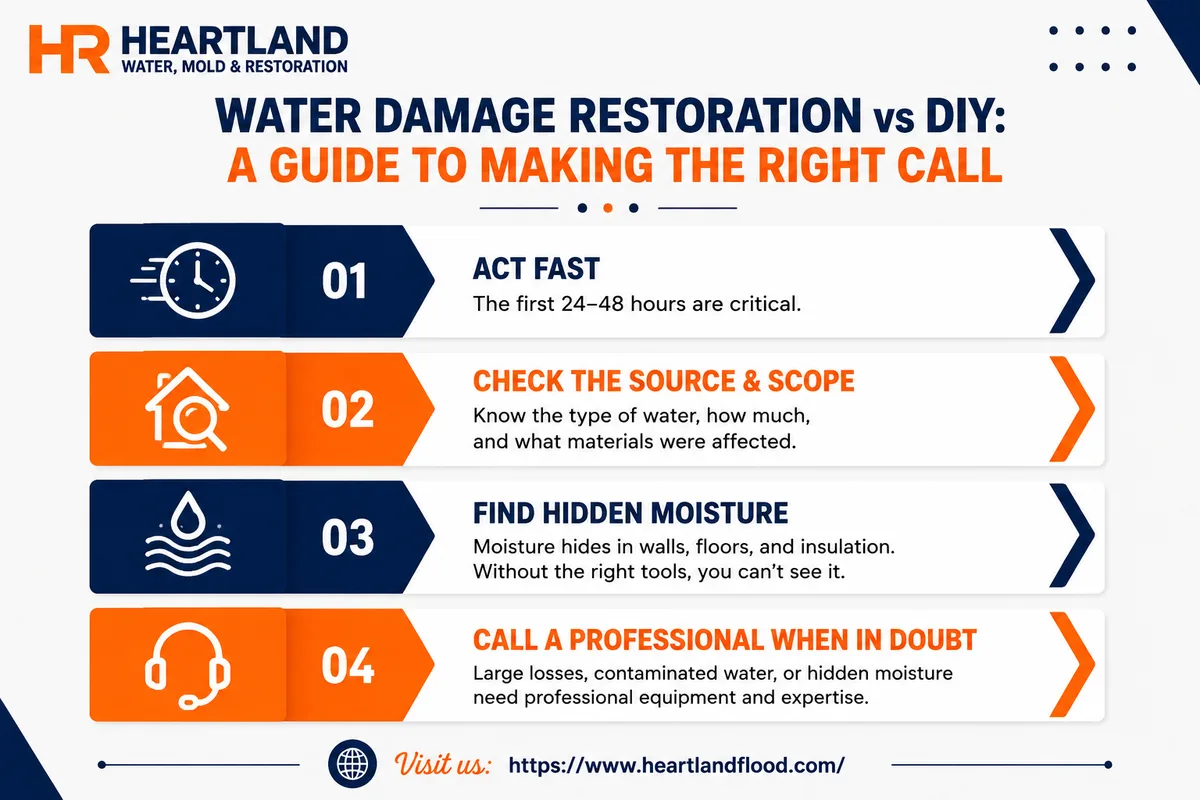
The most common gap between DIY cleanup and professional water damage restoration is not effort or intention. It is equipment capability, and it matters more than most homeowners expect until after the fact.
A household fan moves air across a surface. It does not extract moisture from a saturated subfloor or pull water out of a wall cavity. Consumer dehumidifiers manage everyday indoor humidity; they are not rated to dry waterlogged framing or soaked insulation. The physics are different.
Professional restoration equipment operates at a scale most homeowners have no reference point for. Commercial air movers, high-capacity dehumidifiers, and moisture meters that read water content inside walls and beneath flooring not just at the surface are what actually determine whether a structure is dry versus appearing dry. That distinction is where the problem lives. Wet carpet pad can register as dry on top within a day while staying saturated at its core for days longer. Subfloor panels absorb moisture upward from below and retain it long after the flooring above feels fine underfoot.
That gap between appearing dry and being dry is where most DIY efforts quietly become mold problems four to six weeks later.
The Real Cost of Doing It Yourself
For small, contained situations, DIY is often the right call financially. A weekend rental and a few fans cost less than a professional service call, and for a tile floor with a minor spill caught quickly, that math is correct.
The calculation changes entirely once moisture reaches porous materials - carpet, drywall, wood framing, insulation. A homeowner who runs fans on wet carpet for several days and then discovers mold growth a month later ends up paying for the rental, carpet replacement, mold remediation, and frequently a section of drywall. That total typically exceeds what a prompt professional response would have cost at the outset, often by a significant margin.
Time follows the same pattern. A full weekend monitoring a larger loss, moving furniture, and trying to determine whether a space is genuinely dry is time a trained technician with a moisture meter could resolve in a few hours, with documented certainty rather than educated guessing.
What Happens Inside Walls That You Can't See
This is the section most DIY guides skip, and it is probably the most important one.
Moisture does not stay where it lands. Drywall, baseboards, and wall cavities act as pathways, wicking water horizontally from the original source, sometimes several feet in either direction. A supply line failure under a bathroom vanity can produce a visible wet patch on the cabinet floor while simultaneously sending moisture along the wall framing in a direction that has nothing to do with the visible damage. Three days later, a stain appears on a wall that was never near the water.
Without instruments that measure moisture inside wall assemblies, any DIY water damage assessment is based entirely on what is visible. Visible damage is reliably a small fraction of what has actually been affected. By the time problems announce themselves through bubbling paint, a musty odor, or soft drywall, the underlying moisture has typically been present for days, occasionally weeks.
Mold After Water Damage: The Most Common Consequence of Incomplete Drying
Mold after water damage does not require a major flood event. It requires sustained moisture and roughly 24 to 72 hours, depending on temperature and the materials involved. Surface-level drying creates the impression that a problem has been resolved while moisture stays trapped inside insulation, subflooring, or wall cavities - exactly where mold develops undisturbed and invisible.
By the time growth becomes visible or detectable by smell, the remediation scope is substantially larger than the original water cleanup would have been. Porous materials that cannot be dried in place have to be removed and replaced, not cleaned. Containment barriers and air scrubbing are frequently involved. The cost at that stage is rarely a minor line item.
The pattern - water damage managed independently, mold discovered weeks later, is one of the more common calls restoration companies receive. And the homeowner's consistent observation afterward is almost always the same: they thought it looked dry.
Situations That Call for a Professional
Certain conditions move a situation reliably outside the range of what consumer-grade tools can handle:
- Standing water: present for more than a few hours
- Water contacting drywall or insulation: at any volume
- Sewage backup or exterior floodwater: any Category 3 source
- Water that has spread into multiple rooms or traveled through a ceiling
- Musty odor within the first 24 to 48 hours: mold activity is already present
- Electrical panels or outlets located near the affected area
- Finished basements: carpet, drywall, and insulation are exactly the materials most prone to retaining moisture undetected
None of these guarantee a worst-case outcome, but each one indicates the situation has moved outside the range consumer equipment can reliably close.
A Practical Framework for Making the Call
Four questions produce a more reliable answer than instinct:
- How much water is involved?
- How long has it been present?
- What materials has it contacted?
- Is there any contamination risk?
Small volume, immediate response, hard non-porous surface, clean source: DIY is a reasonable approach. Larger volume, any delay, porous building materials, or contamination risk: professional assessment is the more defensible call - even if the resulting job turns out to be smaller than expected.
If you have reached that decision point and are now evaluating who to call, our guide to choosing a water damage restoration company covers what to look for, how to read an estimate, and the questions worth asking before work begins.
The Bottom Line
Water damage decisions get harder the longer they are deferred, which is why the instinct to assess independently and "see how it looks in a day or two" so reliably produces higher final costs. For most Kansas City homeowners, small and contained clean-water situations are genuinely manageable without professional help. Anything involving significant volume, extended exposure, porous materials, or contamination requires equipment and methodology that is simply not available at the consumer level.
Recognizing that line early and acting within the first day rather than the first available weekend is usually the difference between a contained repair and a project that has grown considerably beyond the original event.
Most of the calls Heartland Restoration receives from Kansas City homeowners start the same way: someone managed the first stage themselves, things seemed fine, and then something changed a smell, a soft spot in the flooring, a stain on a wall that was never near the water. By that point the scope has usually grown beyond what it would have been at day one.
If you're on the fence about whether your situation warrants a professional response, Heartland Restoration will come out and take moisture readings before you commit to anything. That assessment gives you an accurate picture of what's actually in the walls and under the floor, not just what the surface looks like. From there, the decision is yours. Call (913) 213-3686 or request an assessment any time.
Related Reading
Last updated August 24, 2026
Frequently Asked Questions About DIY Water Damage Cleanup
When is DIY water damage cleanup a reasonable option?
DIY can work for a small spill from a clean source, caught within the first couple of hours, on a non-porous surface such as tile or sealed concrete, with no water reaching drywall or insulation. A wet and dry vacuum, towels, fans, and a dehumidifier are usually enough. Once volume, time, material, or contamination changes, call a professional.
How long can water sit before it becomes a serious problem?
Drywall that stays wet for a day or two can support mold growth, hardwood exposed over a weekend can cup or warp, and mold can begin within about 24 to 72 hours depending on temperature and materials. Clean water left more than 48 hours can start to support bacteria, so speed matters more than convenience.
Why can a dry-looking floor still have water damage?
Moisture does not stay where it lands. It wicks through drywall, baseboards, and subfloors, and carpet pad can read dry on top while staying saturated at its core. Without moisture meters that read inside walls and beneath flooring, a visual check only shows a small fraction of what has been affected.
Is a household dehumidifier enough to dry water damage?
For everyday humidity, yes, but not for water damage. Consumer units are not rated to dry waterlogged framing or soaked insulation, and household fans move air across surfaces without extracting moisture from a wall cavity. Professional air movers, high-capacity dehumidifiers, and moisture meters are what confirm a structure is actually dry.
Which water damage situations always need a professional?
Call a professional for standing water that has lasted more than a few hours, any water that reached drywall or insulation, sewage backups or exterior floodwater, water spread across multiple rooms or through a ceiling, a musty odor in the first day or two, electrical panels or outlets near the water, and finished basements.
Does professional water damage restoration cost more than DIY?
For a small, contained spill, DIY usually costs less. Once moisture reaches porous materials, a DIY dry-out that misses hidden moisture can end in carpet replacement, mold remediation, and drywall repair, which often costs more than a prompt professional response would have. A professional assessment with moisture readings shows the true scope before you commit.
Sources & References
- ANSI/IICRC S500 Standard for Professional Water Damage Restoration - IICRC (Institute of Inspection, Cleaning and Restoration Certification)
- National Flood Insurance Program - Flood Insurance & Recovery Guidance - FEMA (Federal Emergency Management Agency)
- National Weather Service Flood Safety - NOAA National Weather Service
Comments
No comments yet.