Safety and contamination check
We check the electrical hazards, confirm where the water came from, and classify it. Floodwater is treated as Category 3, which sets the protective equipment and the cleanup standard for the rest of the job.

Flood Damage Restoration
Updated October 2026
Creek overflow, flash flooding, or storm runoff in your home? Our IICRC-certified crews extract the floodwater, remove what cannot be saved, decontaminate, and dry the structure - on site in 60-90 minutes, 24/7, with documentation for your insurance claim.
Flood damage restoration is the emergency cleanup of a property after outside water gets in. It means a safety check, extracting the water, removing porous materials that cannot be saved, disinfecting because floodwater is contaminated, and drying the structure until moisture readings reach the dry standard. Heartland starts within 60-90 minutes, 24/7, and documents everything for your insurance claim.
Emergency Response Time
A live IICRC-certified responder answers 24/7 and dispatches a truck-mounted crew that reaches most Kansas City metro flood damage calls within 60-90 minutes.
Leave your name and number for flood damage restoration help. We call you back, and the on-site assessment is free.
Emergency right now? Call (913) 213-3686Floodwater is not the same as a pipe leak. When a creek overflows, storm drains back up, or heavy rain pools against the foundation, the water that enters a Kansas City home has already crossed streets, lawns, and sewer lines. Industry standards treat it as Category 3 contaminated water, and that changes every step: what gets removed, what gets disinfected, and how long the structure needs to dry.
Heartland handles the whole job with one crew: emergency extraction, controlled removal of materials that cannot be saved, antimicrobial treatment, structural drying with moisture readings you can see, and the paperwork your adjuster needs. We serve both sides of the state line from our Lenexa base, including Johnson County, Wyandotte County, Jackson County, and Platte County.
| Category | What it means |
|---|---|
| Category 1 | Clean water from a sanitary source, such as a supply line or tub overflow |
| Category 2 | Gray water with significant contamination, such as a dishwasher or washing-machine discharge |
| Category 3 | Black water, grossly contaminated, such as sewage or rising flood water |
The first 24 hours decide the whole job. I tell every homeowner the same thing: start extraction and drying today, because the water you cannot see inside the walls and subfloor is what turns a small repair into a full rebuild.
Flood Cleanup Process
Six steps from the first call to a dry, documented structure
We check the electrical hazards, confirm where the water came from, and classify it. Floodwater is treated as Category 3, which sets the protective equipment and the cleanup standard for the rest of the job.
Truck-mounted extraction pulls standing water out fast, then smaller units reach carpet backing, subfloor surfaces, and the corners a pump leaves behind.
Wet carpet, padding, drywall, and insulation that floodwater touched are cut out and bagged. Taking out the porous material first is what keeps contamination and mold from staying in the walls.
Every surface the water reached is cleaned and treated with an antimicrobial suited to contaminated water, including framing and the slab, before any drying equipment is set.
Commercial air movers and dehumidifiers dry the structure while a technician logs moisture readings every day or two, until every test point reaches the dry standard.
Moisture maps, photos, equipment logs, and an itemized scope go to you and your adjuster, and we coordinate the repair phase so the rebuild starts on a dry structure.
The source of the water decides the cleanup standard and, often, which insurance policy responds. Here is how the two compare for a Kansas City homeowner.
| Question | Water damage | Flood damage |
|---|---|---|
| Where the water comes from | Inside the home: a burst pipe, a failed appliance, a roof leak | Outside the home: creek overflow, storm runoff, groundwater |
| Water category | Usually Category 1 or 2 | Category 3, treated as contaminated |
| Cleanup approach | Dry in place where materials can be saved | Porous materials removed, surfaces disinfected, then dried |
| Typical coverage | A standard homeowners policy often responds | Usually needs a separate flood policy; sewer or sump pump backup is its own endorsement |
Not sure which one you have? Read the difference between water damage and flood damage or whether homeowners insurance covers flood damage. Either way, call first: documenting the source in the first hour protects the claim.
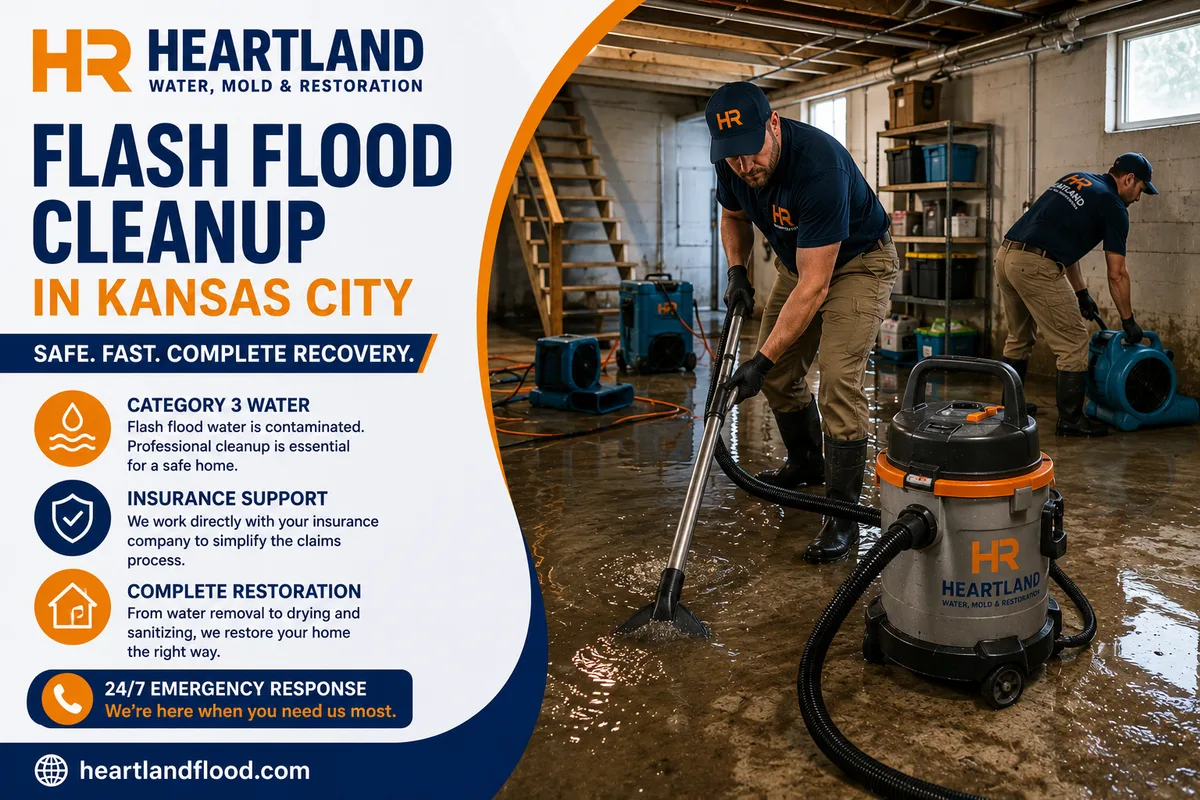
Every part of the cleanup a flood leaves behind, handled by one team:
Basements take the water first and dry last. We extract, remove ruined finishes, disinfect the slab and framing, and dry the structure. See our guide to choosing a basement flood cleanup company.
When a cloudburst overwhelms the street drains, water enters fast and leaves contamination behind. Our flash flood cleanup guide explains why Kansas City neighborhoods flood repeatedly and what to do first.
Backups that come with a flood carry sewage. We handle the extraction and decontamination, and refer you to our sewage cleanup service when the line itself is the problem.
Furniture, electronics, and belongings that can be saved are packed out in labeled crates with an inventory sheet and photos for your insurance claim.
Antimicrobial treatment and verified drying stop mold before it starts. If growth has already appeared, our mold remediation team takes over.
Ruined drywall, carpet, and padding leave on the same visit through our haul away service, so wet debris is not left to feed mold.
We are local, certified, and accountable for the whole job, from the first call to the final moisture reading. Read what Kansas City homeowners say about working with us.
Flood damage comes from outside water such as a creek overflow, storm runoff, or groundwater, so it is treated as Category 3 contaminated water. That means more removal of porous materials, disinfection of every surface the water touched, and longer monitoring than a clean pipe leak. Heartland uses the same crew and equipment for both, adjusted to the water category.
Heartland reaches most Kansas City metro addresses within 60-90 minutes, any hour, because a live IICRC-certified responder dispatches the nearest crew from our Lenexa base. Extraction begins on arrival. Starting in the first day matters, since mold can begin to grow in wet drywall and framing within 24 to 48 hours.
Hard, non-porous items such as metal, glass, and sealed plastic can usually be cleaned and disinfected. Carpet, padding, drywall, and insulation that floodwater touched are typically removed because they cannot be reliably decontaminated. Heartland packs out and inventories salvageable contents and photographs every removed item, so your insurance claim shows what was lost and why.
Cost depends on the area affected, the water category, the materials involved, and how many days of drying the structure needs, so a written scope after a free on-site assessment is the reliable answer. Floodwater cleanup costs more than a clean-water leak because of the added removal and disinfection. Heartland bills covered claims directly to your insurer.
Usually not. Standard homeowners policies exclude flooding, meaning rising water from outside the home, so coverage normally comes from a separate flood policy through the National Flood Insurance Program or a private carrier. A sewer or sump pump backup is a different endorsement. Heartland documents the source and the damage from the first visit so your agent and adjuster can sort out which coverage applies.
Not until the power and the water have been checked. Turn off electricity at the breaker if you can reach it without standing in water, and stay out of rooms with standing water or a sewage odor. Floodwater can carry bacteria and chemicals, and wet materials can hide structural and electrical damage, so wait for a professional assessment before moving back in.
Extraction usually finishes the same day. Structural drying then runs about three to five days for a typical home, longer for a finished basement or a heavily saturated structure, and a technician returns every day or two to take moisture readings. Rebuilding drywall, flooring, and paint is a separate phase that starts once the structure reaches the dry standard.
Heartland serves both sides of the state line: Kansas City KS and MO, Overland Park, Olathe, Lenexa, Shawnee, Leawood, Lee's Summit, Independence, Blue Springs, and Parkville, plus nearby communities across Johnson, Wyandotte, Jackson, and Platte counties. Crews dispatch from our Lenexa base and arrive within 60-90 minutes.
Water Damage Restoration by City
We serve the whole Kansas City metro. For local response times, neighborhoods, and ZIP codes, see our dedicated water damage restoration page for your city:
Don't see your city? View all Kansas City service areas or contact us - we cover both sides of the state line.
Related Reading: KC Storm Season Survival Guide, Water Damage Comparison Guide, and storm damage restoration.
Emergency Help
The first 24-48 hours determine the total cost.
Do not wait - call now for immediate response.