Quick answer: Get everyone out and stay out, then call 911. Do not re-enter until the fire department clears the structure. Contact your insurer to open a claim, secure the property with board-up and tarping, and do not DIY-clean soot. Call a fire and smoke restoration specialist plus a water damage crew.
The First Hours: Safety Before Anything Else
A house fire is life-threatening long after the visible flames are out. Get every person and pet out of the home immediately, move to a safe distance, and call 911 from outside. Do not go back inside for belongings, pets, or documents while the structure is still burning or smoldering.
Even after the fire department knocks the fire down, the building is not safe to enter. Structural members can be weakened, floors can be compromised, and heated air and gases linger. Wait until the fire department formally tells you the structure is cleared before anyone steps back inside.
Once you are out and safe, notify your household, account for everyone, and get medical attention for any smoke inhalation or burns. FEMA's U.S. Fire Administration and Ready.gov both outline these first steps, and the American Red Cross helps families with emergency shelter and essentials after a fire.
Why Smoke and Soot Spread Far Beyond the Burned Room
The room where the fire started is only part of the damage. Smoke is buoyant and driven by heat, so it pushes through doorways, up stairwells, and into the HVAC system, carrying soot into rooms that never saw a flame. Homeowners are often surprised to find black film on walls two floors away from the origin.
Soot particles are extremely small and settle on nearly every surface, including inside cabinets, closets, ductwork, and wall cavities. Because it is so fine, soot works its way into porous materials like drywall, upholstery, and carpet, which is why a fire's odor and residue can persist for weeks.
This wide spread is the reason fire cleanup is a whole-home job, not a single-room wipe-down. A dedicated fire and smoke damage restoration specialist assesses every room, tests residue, and treats the HVAC system so contamination is not simply recirculated back through the house.
Soot Types and Why DIY Cleaning Backfires
Not all soot behaves the same. Dry soot from fast, high-heat fires that burned paper and wood is powdery. Wet soot from slow, smoldering fires that burned plastics and synthetics is oily, smeary, and sticky. Protein residue from kitchen fires is nearly invisible but leaves a strong, hard-to-remove odor.
This is why grabbing a sponge and household cleaner usually makes things worse. Wiping oily soot smears it deeper into paint and grout and can permanently stain a surface that a professional could have salvaged. Water and standard cleaners can also set protein residue rather than lift it.
A fire and smoke specialist matches the cleaning method to the residue type, using dry chemical sponges, specialized solvents, and controlled techniques. Attempting to shortcut that with retail products risks driving residue in, spreading it to clean areas, and altering the damage before it is documented for your insurance claim.
The Water Firefighting Leaves Behind and How It Becomes Mold
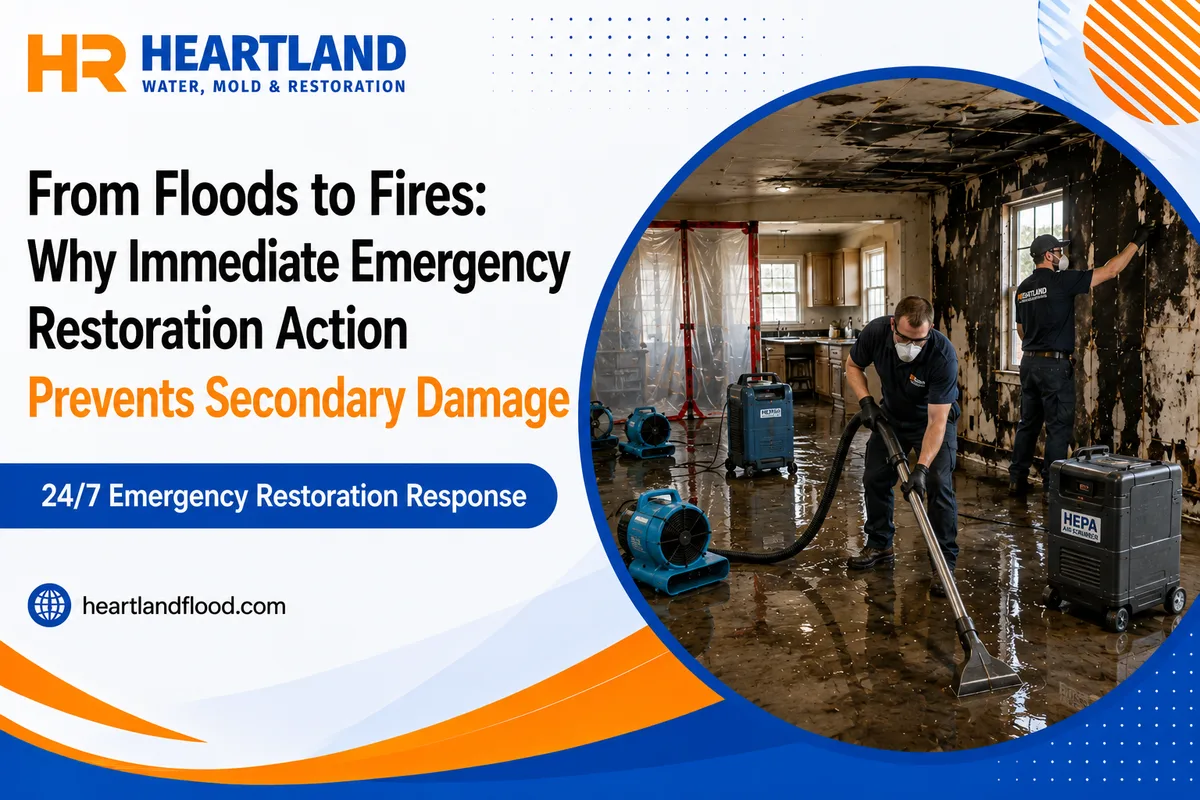
Putting a fire out takes a large volume of water, and hoses and sprinklers can leave hundreds or thousands of gallons soaking into floors, walls, and ceilings. Once the fire is out, that water is a second disaster sitting inside your home, and it is exactly the part of fire recovery that Heartland Flood, Mold and Restoration handles.
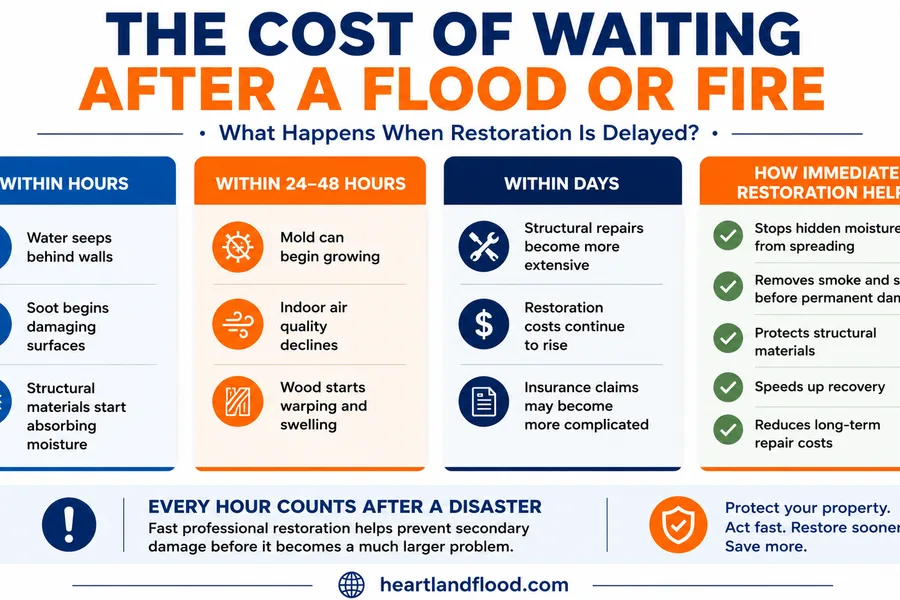
Standing water and saturated materials become a mold problem fast, often within 24 to 48 hours in Kansas City's humidity. Heartland's crews perform water extraction and structural drying to pull moisture out of framing and subfloors before mold takes hold. See how structural drying protects your home after any water event.
Heartland also protects the opened structure with emergency board-up and tarping, prevents secondary damage through mold remediation, and clears fire-damaged debris through debris haul-away. For a fast response after the fire is out, Heartland's 24/7 emergency line at (913) 213-3686 gets the water side moving. Heartland does not clean soot or perform fire rebuilds; that is the fire and smoke specialist's job described below.
Fire Insurance Claims and Documentation
A house fire is a covered peril under a standard homeowners insurance policy, which typically pays for structural repairs, damaged contents, and additional living expenses while you cannot live in the home. Call your insurer as soon as you are safe to open the claim, and write down your claim number and adjuster's contact information.
Documentation protects your payout. Once the fire department clears the home and only if it is safe, photograph and video every room, the origin area, damaged belongings, and the water damage before anything is cleaned or thrown away. Keep receipts for lodging, meals, and emergency supplies, since those often fall under additional living expenses.
Do not discard fire-damaged items until the adjuster has seen them or told you it is fine, because they may be part of your contents claim. Your policy also generally requires you to prevent further damage, which is why prompt board-up, tarping, and water extraction both protect your home and support the claim.
The Professional Fire Restoration Sequence
Full fire recovery follows a predictable order led by a dedicated fire and smoke damage restoration specialist. It starts with inspection and safety assessment, then emergency stabilization such as board-up, tarping, and water removal. After that comes soot and residue cleaning matched to the soot type, followed by odor deodorization, then repairs and reconstruction of what was destroyed.
Heartland's real role sits at the front of that sequence, on the water side. Heartland extracts firefighting water, dries the structure, prevents mold, secures the building with board-up and tarping, and hauls away fire-damaged debris. Heartland does not perform soot cleanup, thermal fogging, ozone or other deodorization, contents pack-out for fire, or fire rebuilds.
For the smoke, soot, odor, and structural rebuild, you coordinate a fire and smoke damage restoration specialist. The cleanest path is to run both trades in parallel: Heartland removes the water and prevents mold while the fire specialist handles residue and reconstruction, so drying is not delayed while soot work is scheduled. The interplay of fire and water damage is covered in why immediate emergency restoration prevents secondary damage.
Who to Call and When
Your first call is always 911 from a safe spot outside. Your second call, once you are safe, is your insurance company to open the claim and get guidance on covered emergency services. The American Red Cross can help with immediate shelter, food, and essentials the same day.
For the physical recovery, call two kinds of restoration pros. Call a fire and smoke damage restoration specialist for soot cleaning, deodorization, and rebuilding the burned areas. Call Heartland Flood, Mold and Restoration for the firefighting water: extraction, structural drying, mold prevention, emergency board-up and tarping, and debris haul-away.
Time matters most on the water side, because mold can start within a day or two. Heartland offers 24/7 emergency response at (913) 213-3686, and you can request a visit through instant booking. Getting the water out early protects the parts of the home the fire itself did not destroy.
Frequently Asked Questions About Fire and Smoke Damage
What is the very first thing to do after a house fire?
Get everyone out of the home and stay out, then call 911 from a safe distance outside. Never go back inside for pets, documents, or belongings while the home is burning or smoldering. Once you are safe, account for everyone and get medical care for any smoke inhalation or burns before doing anything else.
When is it safe to go back inside after a house fire?
Only after the fire department formally tells you the structure is cleared. Even with no visible flames, a fire-damaged home can have weakened framing, compromised floors, smoldering hot spots, and lingering toxic gases. Wait for the official all-clear, and if the building is condemned or unstable, respect that and do not re-enter.
Can I clean soot myself after a fire?
It is strongly discouraged. Soot is oily and fine, so wiping it with household cleaners usually smears it deeper and permanently stains surfaces a professional could have saved. DIY cleaning can also spread residue to unaffected rooms and alter the damage before your adjuster documents it, which can hurt your insurance claim.
Does homeowners insurance cover fire damage?
Yes. Fire is a covered peril under a standard homeowners policy, which typically pays for structural repairs, damaged belongings, and additional living expenses while your home is uninhabitable. Call your insurer as soon as you are safe to open a claim, document everything before cleanup, and keep receipts for lodging, meals, and emergency supplies.
Why is there water damage after a fire?
Extinguishing a fire takes a large volume of water from hoses and sprinklers, often hundreds or thousands of gallons that soak into floors, walls, and framing. Once the fire is out, that water sits inside your home and can trigger mold within 24 to 48 hours, which is why fast extraction and structural drying are critical.
Does Heartland do fire and smoke damage restoration?
Heartland handles the water side of a fire aftermath, not the fire itself. That means firefighting water extraction, structural drying, mold prevention, emergency board-up and tarping, and hauling away fire-damaged debris. For soot cleanup, deodorization, and rebuilding the burned areas, you coordinate a dedicated fire and smoke damage restoration specialist.
How fast can mold grow after firefighting water soaks a home?
Mold can begin growing within 24 to 48 hours on wet materials, and Kansas City humidity speeds that up. Standing water and saturated drywall, carpet, and framing are ideal for mold. Removing the water and drying the structure quickly is the single most effective way to prevent a mold problem on top of the fire damage.
Do I need more than one contractor after a house fire?
Usually yes. Full recovery involves two trades working in parallel. A fire and smoke damage specialist handles soot cleaning, odor removal, and reconstruction of the burned areas. A water damage crew like Heartland handles firefighting water extraction, drying, mold prevention, board-up, and debris haul-away, so drying is not delayed while soot work is scheduled.

Comments
No comments yet.