

Quick answer: Sewage flooding carries live pathogens deep into porous basement materials, establishes mold within 24 to 48 hours, and can spread through HVAC systems to the whole home. Only certified Category 3 extraction, with containment, material removal, structural drying, and post-remediation testing, fully resolves the contamination. Cleaning only what is visible leaves active contamination in place.
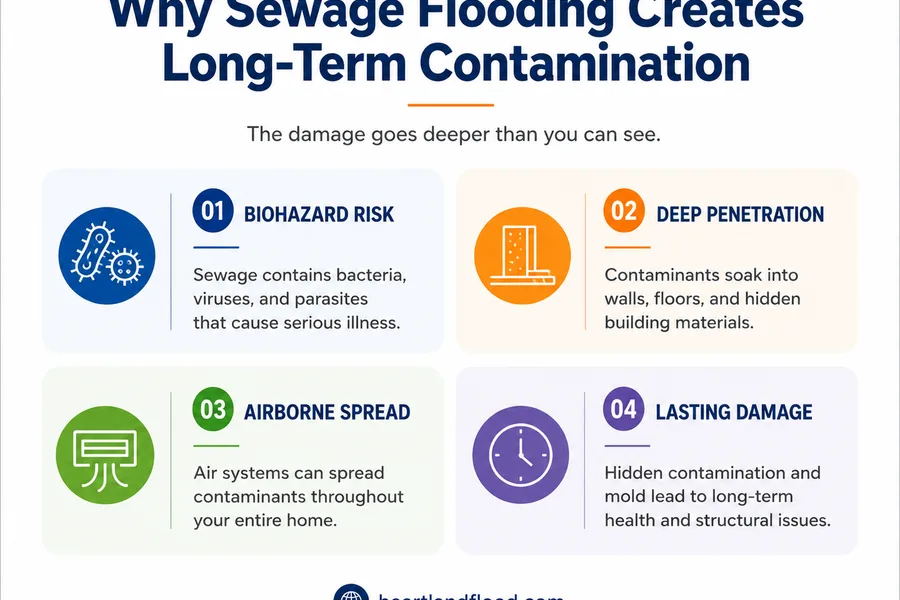
Unlike a burst pipe or rainwater intrusion, sewage carries a concentrated biological load: bacteria, viruses, parasites, and chemical compounds that absorb into your walls, subfloor, and concrete long before the puddles are gone. The contamination becomes invisible quickly. The consequences do not. If sewage has entered your home, certified sewage cleanup is not an upgrade, it is the baseline for making the space safe again.
Why Sewage Flooding Is More Dangerous Than Regular Water Damage
A slow pipe leak is a moisture problem. Sewage flooding is a biohazard cleanup situation. That distinction matters for every decision that follows, from what protective equipment is needed to which materials can be saved and whether the space is safe to occupy afterward. The reason for the Category 3 designation is the biological load that sewage carries: bacteria such as E. coli and salmonella, viruses such as hepatitis A and norovirus, parasites such as cryptosporidium and giardia, and chemical byproducts such as ammonia and hydrogen sulfide.
These are not trace amounts. A drain line failure or sewer main backup delivers these organisms in volume, and they remain viable on surfaces and inside porous materials for days to weeks. In a Kansas City basement during summer, where humidity regularly holds above 60 percent, those conditions actively support microbial survival and growth. Exposure does not require swimming in the flood, since skin contact, inhalation of airborne particles, or touching contaminated materials and then your face are all documented exposure routes.
How Sewage Contamination Spreads Beyond the Flooded Basement
Porous Materials Absorb Contamination Below the Surface
Concrete looks solid but is genuinely porous. Drywall begins absorbing moisture within minutes. Insulation batts act like sponges, and wood framing wicks contaminated water upward past the visible waterline. Moisture mapping with thermal imaging and calibrated meters regularly shows saturation extending 12 to 18 inches above the visible flood level, through wall cavities that look completely dry from the outside. Sewage cleanup that stops at what is visible leaves active contamination in place.
HVAC Systems Can Distribute Contamination
Return air vents, ductwork, or air handling equipment near the basement create a secondary contamination pathway. Sewage aerosols are small enough to stay suspended in air and get pulled into duct systems, then travel to every room the system serves. What begins as a basement backup becomes a whole-home indoor air quality problem, which is why HVAC inspection and cleaning is a required step, not an optional add-on.
Mold Establishes Within 24 to 48 Hours
Sewage creates ideal conditions for mold: consistent moisture, an organic nutrient load, and warmth. Once mold establishes inside a wall cavity or beneath flooring, surface spraying does not reach it. Mold prevention at that point means removing the affected material, not treating it in place. The longer the delay, the more material falls into the remove category rather than the save category. Our guide to professional mold removal after water damage explains the warning signs.
Improper Cleanup Spreads Contamination Further
The cleanup process itself becomes a contamination vector when done without proper protocols. Walking through the area without shoe covers tracks pathogens into clean spaces, and running a consumer shop vac aerosolizes contaminants through the motor exhaust. This is a core reason why DIY sewage cleanup in flooded basements so frequently results in ongoing problems that cost more to fix than the original professional remediation would have.
The 72-Hour Window: Why Response Time Affects Remediation Scope
There is a measurable relationship between time elapsed after a sewage backup and the scope of work required, and it accelerates rather than progressing in a straight line. Within the first 24 hours, contamination is largely confined to direct contact areas. Between 24 and 48 hours, microbial growth becomes established in porous materials. Beyond 72 hours, that growth is entrenched, meaning material removal becomes the standard protocol. Drywall that might have been salvaged must now come out, and subfloor sections that could have been dried in place require demolition.
From a cost standpoint, same-day certified extraction almost always results in a smaller scope and lower total cost than a response delayed by even 24 hours. Heavy Midwest storm seasons compound this further, since aging sewer infrastructure across the Kansas City metro means combined sewer overflows and lateral line backups happen during high-rain periods, often when multiple properties need remediation at once.
What Certified Sewage Extraction Actually Involves
Containment and Safety Setup Come First
Before extraction begins, the affected area is physically isolated. Poly barriers seal doorways, and negative air pressure machines with HEPA filtration draw airborne particles toward the machines rather than the rest of the home. Technicians work in full PPE: Tyvek suits, respirators rated for biological hazards, double gloves, and eye protection. This prevents the remediation team from becoming a contamination transport mechanism.
Extraction, Disinfection, and Material Removal
Standing sewage is extracted with appropriate equipment and disposed of properly, not drained back into a household system. All affected surfaces then receive EPA-registered biocides at verified concentrations, with the dwell time the product needs to actually neutralize pathogens. Porous materials that cannot be fully decontaminated are removed, with cuts made at the next stud bay beyond the confirmed moisture boundary, because visible damage consistently understates actual penetration. The EPA mold cleanup guidance reinforces removing saturated porous materials rather than treating them in place.
Structural Drying and Verification
Industrial dehumidifiers and air movers are positioned from a drying plan calculated from cubic footage, material types, and measured moisture readings, and daily readings drive equipment adjustments. The space is not cleared when it feels dry, it is cleared when measured moisture content reaches defined targets. Finally, surface swab sampling and air quality testing verify that contamination has been reduced to acceptable thresholds before reconstruction, producing the documentation that matters for insurance claims and future property disclosures.
What Incomplete Sewage Remediation Leaves Behind
- Structural deterioration: Residual moisture in framing typically becomes visible 12 to 18 months later, when the connection to the original event is no longer obvious but the cost is far higher.
- Chronic indoor air quality problems: Ongoing microbial activity in basement walls can expose residents to low-level contamination through shared air circulation.
- Lingering sewage odors: Odor that returns weeks later almost always means contamination remains in porous materials that masking sprays cannot fix.
- Property disclosure liability: A future home inspection that finds elevated moisture, mold, or odor compounds can trigger renegotiation or a failed sale.
Immediate Steps After a Basement Sewage Backup
- Do not enter without protection. Rubber gloves, an N95 mask, and eye protection at minimum, plus disposable shoe covers if you have them.
- Do not run a shop vac. Consumer vacuums aerosolize contaminants through the motor exhaust.
- Turn off the HVAC system to prevent contaminated air from circulating to other floors.
- Document everything before touching anything, including water height on walls and any visible material damage.
- Contact a certified restoration company immediately and ask specifically about Category 3 credentials.
Time is the one variable you can control. Faster certified response consistently produces a smaller scope, lower cost, and better outcome. Heartland Restoration handles Category 3 sewage remediation throughout the Kansas City metro with IICRC-certified technicians. Call (913) 213-3686 or reach our team any hour.
Last updated July 15, 2026
Frequently Asked Questions
Can I use the basement while sewage remediation is happening?
If proper containment with negative air pressure has been established, upper-floor spaces are typically safe to occupy. The affected basement area itself should not be entered except by remediation technicians in proper PPE until clearance testing confirms the space is safe.
What basement materials usually cannot be saved after sewage flooding?
Standard drywall, carpet and carpet padding, paper-faced insulation, and particleboard subflooring are typically non-salvageable after sewage contact, because they are porous and cannot be fully decontaminated in place.
Why does sewage odor come back weeks after cleanup?
Returning odor almost always indicates that contaminated material remains inside walls or under flooring. Odor-masking products do not address the source, because the organic compounds causing the smell are embedded in porous material and require physical removal or deep decontamination.
How quickly can mold become a problem after a sewage backup?
Mold colonization can begin on porous materials within 24 to 48 hours of sewage contact, and it becomes progressively more difficult to address as it establishes deeper in wall cavities and subflooring. In a humid Kansas City summer, that window can be even shorter.
Why does bleach not fix sewage contamination in a basement?
Bleach disinfects non-porous surfaces when applied correctly, but it does not penetrate porous materials where pathogens have migrated. It also degrades rapidly in organic environments, making it unreliable as a standalone sewage cleanup solution.
Does a sewage backup always require professional remediation?
Any sewage backup that contacts porous materials such as drywall, wood, concrete, or insulation requires certified professional sewage cleanup to fully eliminate contamination. DIY methods cannot achieve the decontamination depth required in those materials and typically leave active contamination in place.
How do I know if my insurance covers basement sewage backup?
Check your homeowner policy for a water and sewer backup rider or endorsement. Standard policies exclude this type of damage, so coverage only applies if the rider was specifically added. Contact your insurer directly to confirm before you need to file a claim.
Sources & References
- ANSI/IICRC S500 Standard for Professional Water Damage Restoration - IICRC (Institute of Inspection, Cleaning and Restoration Certification)
- Mold, Dampness, and Cleanup After Water Damage - Centers for Disease Control and Prevention
- A Brief Guide to Mold, Moisture and Your Home - U.S. Environmental Protection Agency
Comments
No comments yet.