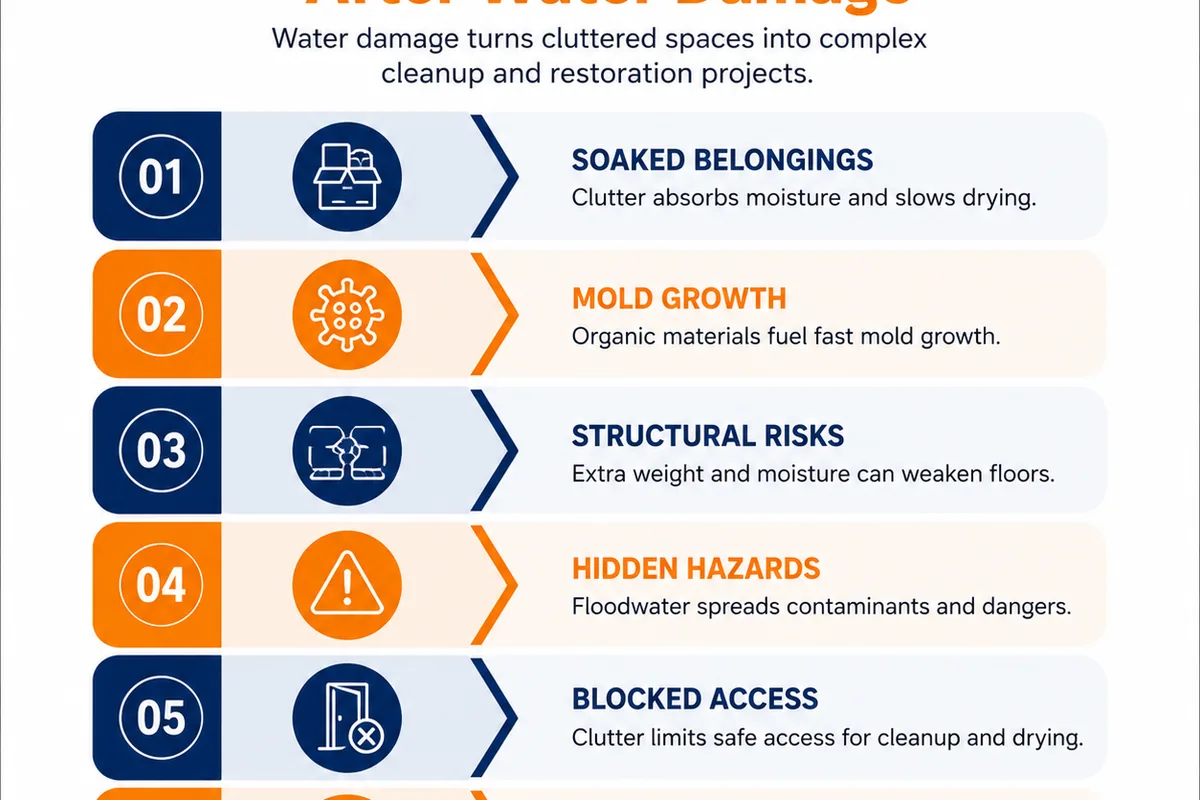
Quick answer: Water damage in a hoarded home multiplies every existing problem. Saturated belongings keep the structure from drying, added water weight can cause floor collapse, and floodwater spreads contamination across the whole floor plan. These jobs require biohazard-trained crews, careful three-category triage, patient homeowner communication, and the right sequence of removal, extraction, and mold remediation.
These jobs are genuinely different, not harder in the way a bigger house is harder, but different in the kind of thinking, crew, and patience required. Homeowners, insurance adjusters, and even experienced contractors consistently underestimate what they are walking into. When water damage meets a hoarded home, professional haul away and cleanout services and restoration have to work together from the very first assessment.
Water Multiplies Every Existing Problem
The contents of a hoarded home do not just sit in the water, they absorb it. Cardboard boxes, mattresses, stacked clothing, newspapers, and upholstered furniture pull in moisture and hold it like a sponge. Long after standing water has been extracted, the contents keep releasing humidity into the air and into the surrounding walls and floors.
- Drying stalls: A normal water-damaged home dries in four to six days with proper equipment. In a hoarded environment, the structure may never fully dry because equipment cannot reach it and saturated belongings keep feeding the problem.
- Weight becomes a hazard: Saturated cardboard alone is several times heavier than dry. Added to floors already stressed by years of accumulated load, subfloor collapse becomes a documented risk.
- Contamination spreads: Floodwater carries decomposed food, animal waste, chemical containers, and medications across the entire floor plan, in ways that are not visible on the surface.
What Crews Are Actually Walking Into
Before anyone enters a water-damaged hoarded property, they need to understand what is in there. This is not standard water damage work, and standard PPE is not sufficient.
- Biohazard contamination is present on nearly every severe hoarding case that has flooded. Human and animal waste, decomposed organic material, and spoiled food are common, and floodwater distributes all of it.
- Mold moves fast. Colonization normally begins within 24 to 48 hours, but in a hoarded home where organic material is abundant and airflow is blocked, visible colonies can appear within the first day.
- Hidden structural failure is the hazard that injures workers. You cannot see the floor or the walls, and a crew member who steps onto a compromised subfloor is at serious risk of falling through.
- Buried sharps and chemical hazards such as broken glass, syringes, corroded cans, and old medications are embedded throughout the accumulation and become invisible in floodwater.
Proper protective equipment for these jobs includes Tyvek suits, cut-resistant gloves under nitrile, full-face respirators rated for mold and biohazard, and steel-toed waterproof boots. This is the minimum standard for entry.
Why You Cannot Skip the Sorting Step
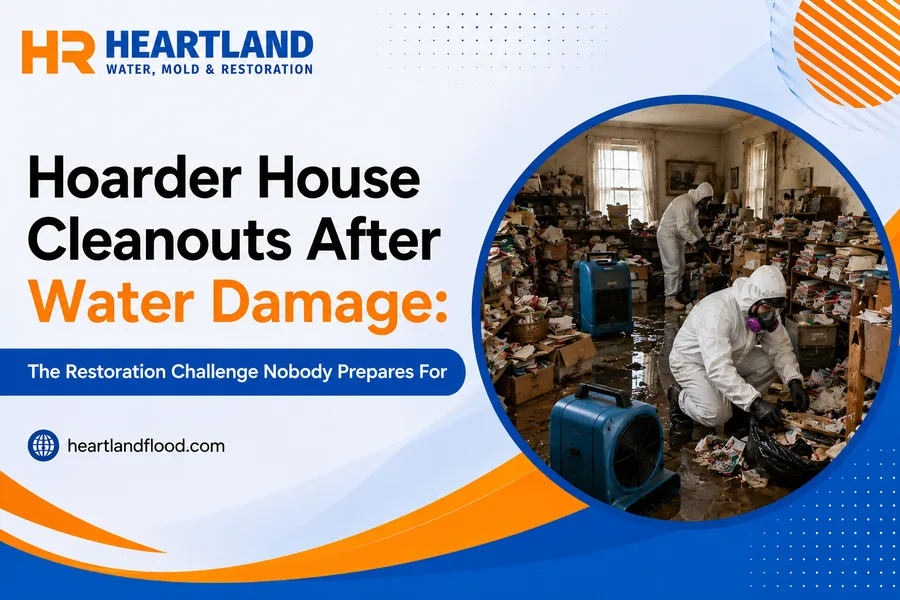
The instinct when standing inside a flooded hoarder home is to call for a dumpster and start loading. That instinct creates legal exposure and can cause serious harm. Even in the most severe cases, the contents include financial records, legal documents, family photographs, prescription medications, jewelry, and items of genuine value buried within what looks like garbage. Beyond the human dimension, improper disposal of hazardous chemicals, electronics, and certain medications carries legal liability.
The right approach uses a three-category triage system:
- Salvageable with value: items that can be cleaned, dried, and returned, such as documents, sealed containers, and non-porous valuables.
- Damaged but properly disposable: water-damaged material with no salvage value that requires standard disposal.
- Biohazardous material: anything contaminated with waste, mold-colonized organic material, sharps, or chemical hazard, which requires bagged, labeled disposal and cannot go into a standard dumpster.
This sorting process slows the job down, and it is also not optional if the job is going to be done correctly.
Talking to the Homeowner Is a Skill, Not an Afterthought
Hoarding disorder is a recognized clinical condition, and the relationship a person with it has with their belongings involves genuine psychological distress when items are removed, even items that are visibly ruined. Water damage throws this into crisis. Many homeowners will refuse entry, insist that waterlogged items can be saved, or become so overwhelmed that progress stalls completely. Teams that work these jobs successfully treat the conversation as part of the technical work:
- Explaining every step before it happens, not after
- Involving family members or case managers when available and appropriate
- Never dismissing or belittling the homeowner attachment to specific items
- Working in stages that build trust before full-scale removal begins
- Documenting what is removed, in what condition, and where it goes
Patience and communication are not soft skills in this work. They are operational requirements.
The Step-by-Step Process That Actually Works
- Preliminary assessment before entry: walk the exterior, identify structural concerns, and check for gas leaks or live electrical panels in contact with water.
- Hazard mapping on entry: do not begin removal. Map the space, identify soft floor areas, mark biohazard zones, and photograph everything before anything moves.
- Staged content removal: begin at the perimeter and work inward, clearing pathways first so equipment and personnel can move safely.
- Water extraction once the floor is accessible: extraction equipment needs floor contact and clear space, so it cannot happen until enough content is removed.
- Full structural exposure and assessment: once contents are cleared, the true damage picture becomes visible, and the scope frequently changes.
- Mold remediation before drying completes: mold-affected materials are removed or treated under containment, because running air movers around active colonies spreads spores.
- Rebuild from a clean, dry, verified-sound structure: reconstruction begins only after moisture readings pass and any mold remediation is cleared.
What Insurance Will and Will Not Cover
Filing a water damage insurance claim on a hoarded property requires more preparation than a standard claim. Standard policies cover sudden, accidental water damage but exclude damage attributed to neglect, pre-existing conditions, and gradual leaks. In a hoarded home where a slow leak may have gone unnoticed behind stacked belongings for months, adjusters look closely at the cause and timeline. To protect the claim, document before anything moves with a video walkthrough of the entire property, and get a detailed written scope that specifies biohazard remediation, extended drying, content triage labor, and structural assessment separately. At Heartland Restoration, we work directly with adjusters on hoarding cleanup projects and provide the documentation that helps support your claim.
After the Cleanout: Why the Job Is Not Finished When the Walls Are Dry
A structurally restored property is not a solved problem if the conditions that led to the hoarding have not been addressed. Without support, hoarded homes frequently return to their previous state within months. The restoration work creates an opportunity, but only if the homeowner has the right support structure to maintain it. That means mental health resources specific to hoarding disorder, such as the International OCD Foundation hoarding resources, practical maintenance systems, and follow-up from the restoration team. Heartland Restoration approaches post-cleanout recovery as a process rather than a single event, connecting homeowners with the community resources they need. Call (913) 213-3686 or reach our team to talk through a hoarding cleanout.
Frequently Asked Questions
How long does a hoarder house cleanout after water damage usually take?
The timeline depends on the level of clutter and water damage, but most projects take several days to a few weeks to complete safely. Rushing the sorting and structural assessment steps is how workers get hurt, so a careful crew works in stages rather than in a single day.
Can belongings be saved after water damage in a hoarder home?
Some non-porous and valuable items may be restored if addressed quickly, while heavily contaminated or waterlogged materials often need to be discarded. Even in severe cases, a proper three-category triage protects financial records, documents, photographs, and items of genuine value.
Why is a hoarder house more difficult to restore after flooding?
Excess clutter traps moisture, hides structural damage, restricts drying, and increases the risk of mold growth and safety hazards. Saturated belongings keep feeding humidity into the structure, so a home that would normally dry in days may never fully dry until the contents are cleared.
Does homeowners insurance cover hoarder house water damage restoration?
Coverage depends on your policy and the cause of the water damage. Standard policies cover sudden, accidental water damage but exclude gradual leaks and neglect, so documenting the damage with a video walkthrough before anything moves and getting a detailed written scope are both important.
Is professional restoration necessary after water damage in a hoarded property?
Yes. Professional teams have the equipment and expertise to safely remove hazards, dry hidden moisture, and restore the property properly. The combination of biohazard contamination, hidden structural failure, and buried sharps makes standard DIY cleanup genuinely dangerous.
How quickly can mold develop after water damage?
Mold can begin growing within 24 to 48 hours when moisture is left untreated. In a hoarded home, where organic material is abundant and airflow is blocked, visible colonies can appear even faster, which makes immediate cleanup and drying essential.
What should homeowners do first after discovering water damage in a hoarder house?
Stop the water source if it is safe to do so, avoid disturbing contaminated areas, document the damage, and contact a professional restoration company as soon as possible. Involving family members or a case manager early also helps the process go more smoothly.

Comments
No comments yet.